Frequently Asked Questions:
What are the different Battery Types and their Best Applications?
Starting Batteries
Flooded Starting Batteries: Ideal for cars, trucks, and motorcycles with internal combustion engines.
AGM Batteries (Absorbent Glass Mat): Maintenance-free and perfect for start-stop vehicles, backup power, and power sports.
Gel Batteries
Gel Batteries: Designed for deep-cycle use in renewable energy systems, marine applications, and mobility devices.
Deep Cycle Batteries
Deep Cycle Flooded Batteries: Durable and reliable for golf carts, forklifts, RV’s, and solar systems.
Deep Cycle AGM Batteries: Combines deep cycling and maintenance-free technology for off-grid solar, marine, and RV applications.
How do I know which battery is right for my vehicle or system?
Choosing the right battery depends on your specific needs. Here’s a quick guide:
- For traditional vehicles, go with a Flooded Starting Battery.
- For start-stop or modern vehicles, consider an AGM Battery.
- For renewable energy or marine systems, a Gel or Deep Cycle Battery works best.
What is the difference between AGM and Flooded Batteries?
AGM Batteries:
- Spill-proof Design: The absorbed electrolyte design prevents leakage, making it safe for installation in various positions.
- Low Internal Resistance: Provides higher efficiency during charging and discharging, making it suitable for high-demand applications.
- Longer Shelf Life: Holds charge longer when stored, compared to flooded batteries.
- Ideal for Modern Features: Performs well with energy-intensive systems like start-stop technology and infotainment.
Flooded Batteries:
- Requires Ventilation: Emits gases during charging and needs proper ventilation for safety.
- Widely Available: More commonly available and familiar to most vehicle owners.
- Higher Initial Capacity: Can often deliver slightly more power initially than AGM batteries of the same size.
- Shorter Lifespan: Typically has a shorter cycle life compared to AGM batteries, especially under heavy use.
Can I mix different types of batteries?
It is not recommended to mix different types of batteries. If your system uses AGM batteries and you need to replace one, it’s best to stay with the same AGM type to maintain optimal performance and compatibility.
The same principle applies to battery age. For example, in a dual-battery setup in a truck, if one battery fails and both batteries are over two years old, it’s advisable to replace both. This prevents unnecessary stress on the new battery and ensures consistent performance across the system.
For personalized advice on your battery setup, feel free to contact us at (435) 628-6248.
Two 6-volts Golf Batteries or Two 12-volts Deep Cycle Batteries for my camper. Which is Better?
The easiest way to explain this is to look at the batteries as a gas tank on your car. The bigger the tank the longer you can drive between fill-ups. What the batteries are storing is electrical potential. A 6-volt “golf cart” battery has 235 Ahr versus the group 24 “Marine/RV” battery has 84 Ahr. In both scenarios you need two batteries. For the six volts, you hook them up in series and this creates a 12-volt system. The lights, heater, charger, etc. all “see” 12-volts. The amperage remains the same at 235 Ahr. The 12-volt batteries are hooked together in parallel, meaning the voltage stays at 12-volts, but the amperage doubles to 168 Ahr. The short answer is the two golf cart batteries have bigger “tanks” so they can last longer. The golf cart battery was designed to do far more than the standard Marine/RV battery so it performs very well in that application.
Why should I reset my Battery Management System (BMS)?
Resetting your BMS ensures your vehicle accurately recognizes a new battery, improving performance and prolonging its lifespan. This is a required service for some vehicles. At Dixie Battery Exchange, we offer BMS reset services for all vehicle types.
How do I know if I have a Battery Management System or Intelligent Battery System?
Battery Management Systems can be found in the following types of vehicles:
- Vehicles with Start-Stop Features: These systems automatically turn off the engine when the vehicle is stationary and restart it as needed, helping to conserve fuel and reduce emissions.
- German Vehicles: All German-manufactured vehicles, including brands like BMW, Mercedes-Benz, Audi, Volkswagen, and Porsche, are typically equipped with advanced battery management systems.
- Hybrid or Electric Vehicles: These vehicles rely on sophisticated battery management to optimize performance, charging, and longevity.
- Vehicles with Dual Battery Systems: Commonly found in larger trucks, vans, and SUVs, dual battery setups often include a BMS to manage the additional electrical demand.
If there are any questions or if additional guidance is needed, please refer to the vehicle’s specific service manual, contact the manufacturer or call us at (435) 628-6248. We’re happy to look it up for you!
What do I do to get more Amp Hours or More Voltage from a multi battery set up?
Batteries can be hooked up in Parallel, Series or direct. You can also combine Parallel and Series to get additional benefits. Refer to the figure below to see the different ways you can hook up a set of batteries and how it changes the Voltage and Amp Hours.
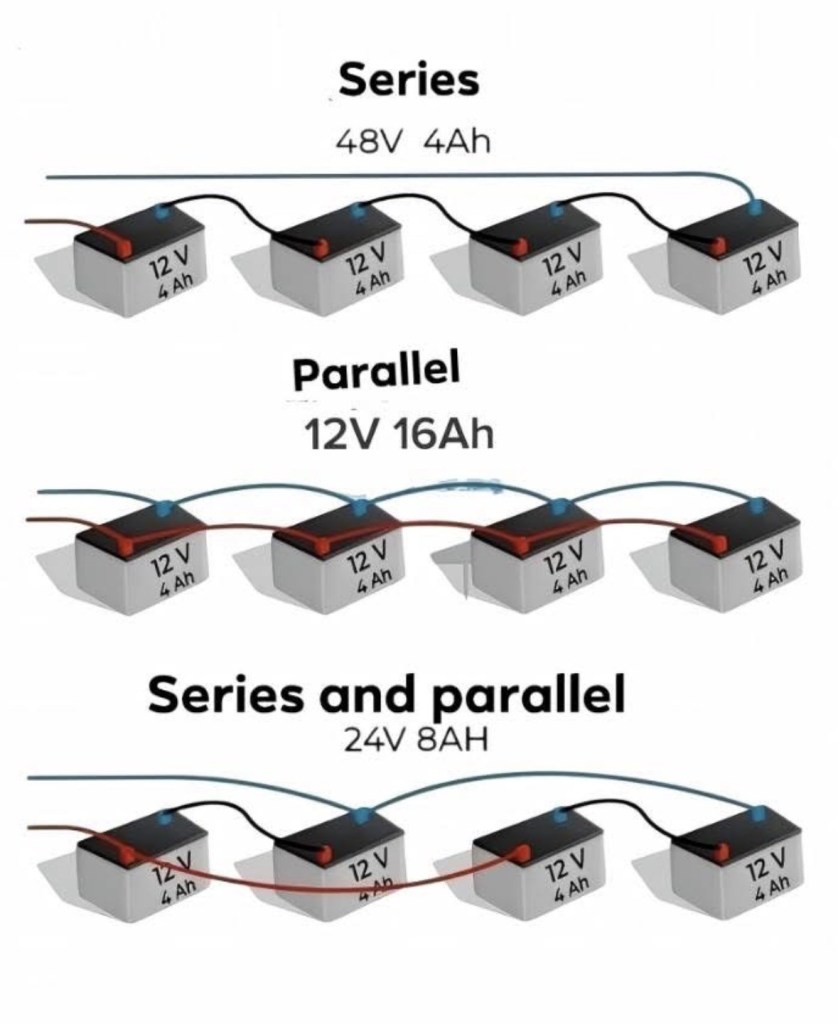
Please note if you are hooking up multiple batteries together they should be of the same internal technology. (I.e. Only hook up AGM’s with AGM’s and Flooded batteries with other Flooded Batteries)
If there are any questions or if additional guidance is needed, feel free to call us at (435) 628-6248. We’re happy to help!
What is the impact of temperature on battery life?
While it’s impossible to precisely predict a battery’s lifespan, years of testing have shown clear patterns. Extreme heat significantly shortens battery life by accelerating chemical reactions within the battery, leading to degradation.
Although extreme cold is less common here, winter temperatures can still expose a weak or failing battery. If your battery is nearing the end of its life, the colder months will often make these issues more noticeable. The phrase “Heat kills, and cold reveals” rings true, especially in climates like Southern Utah.
For the best performance, regular battery testing and maintenance are key, especially before seasonal temperature changes.
For the best performance, regular battery testing and maintenance are key, especially before seasonal temperature changes.
Why did my battery freeze?
A fully charged battery won’t freeze till 76 degrees Fahrenheit BELOW freezing? Yet a fully discharged battery will freeze at 32 degrees Fahrenheit, just like water. If your battery froze, it is because it was discharged. Just like a can of Coke in the freezer, the fluid in the battery expanded and could have damaged the case or the plates inside the battery. Best case scenario, place the battery in a warm location for several days until it is no longer frozen, then attempt to recharge. Freezing voids all warranties as it is not the battery’s fault it got discharged in a cold environment. Bring your battery in and we’ll charge it for you.
I left my lights on, can I just drive my car to recharge my battery?
An alternator’s primary function is to maintain a battery’s state of charge, not to fully recharge it. In most vehicles, the alternator is designed to match the electrical demands of a running car, compensating for the load but offering little extra power for charging a discharged battery.
If your battery is deeply discharged, relying on your alternator alone is not enough. Unless you’re planning a long drive, like a trip to Salt Lake City and back, you’ll need to use an external charger to bring your battery back to full capacity. This helps prevent being stranded due to an undercharged battery.
What services does Dixie Battery Exchange provide?
We offer:
- Sales of AGM, Flooded, Gel and reconditioned batteries.
- Free battery testing and in-store installation.
- Mobile service for roadside battery replacement starting at $90
- BMS resetting for optimal vehicle performance for $50 ($25 with purchase of battery).
Why is battery recycling important?
Recycling batteries prevents harmful chemicals and heavy metals from polluting the environment while conserving valuable resources like lead and plastic. At Dixie Battery Exchange, we are committed to sustainability and make it easy for you to recycle your lead-acid batteries responsibly. Together, we can support a cleaner, healthier future.
What about lithium?
Lithium batteries offer significant advantages in certain situations, such as lightweight design, higher energy density, and longer lifespans. However, like any advanced technology, they come with tradeoffs, such as higher upfront costs, narrow operating environments, and specific charging requirements. It’s important to weigh these benefits and limitations based on your unique needs.
Currently, we do not test, charge, or sell lithium batteries. However, our team is happy to answer your questions and guide you toward the best solution for your situation.
How do I recycle Non Lead-Acid batteries like Lithium, Nickle or Iron?
Currently, we do not have the ability to recycle Non Lead-Acid batteries. However, a company called Veolia Environmental Services can. They can be reached through a form on their website. https://www.veolianorthamerica.com/what-we-do/waste-capabilities/contact-representative
How often should I test my battery?
We recommend testing your battery every six months, especially before extreme weather seasons. Stop by for a free battery test anytime!
Do you only serve Southern Utah?
While we are based in Saint George UT, we strive to accommodate customer needs wherever possible. Contact us to discuss your specific location and requirements at (435) 628-6248.
